
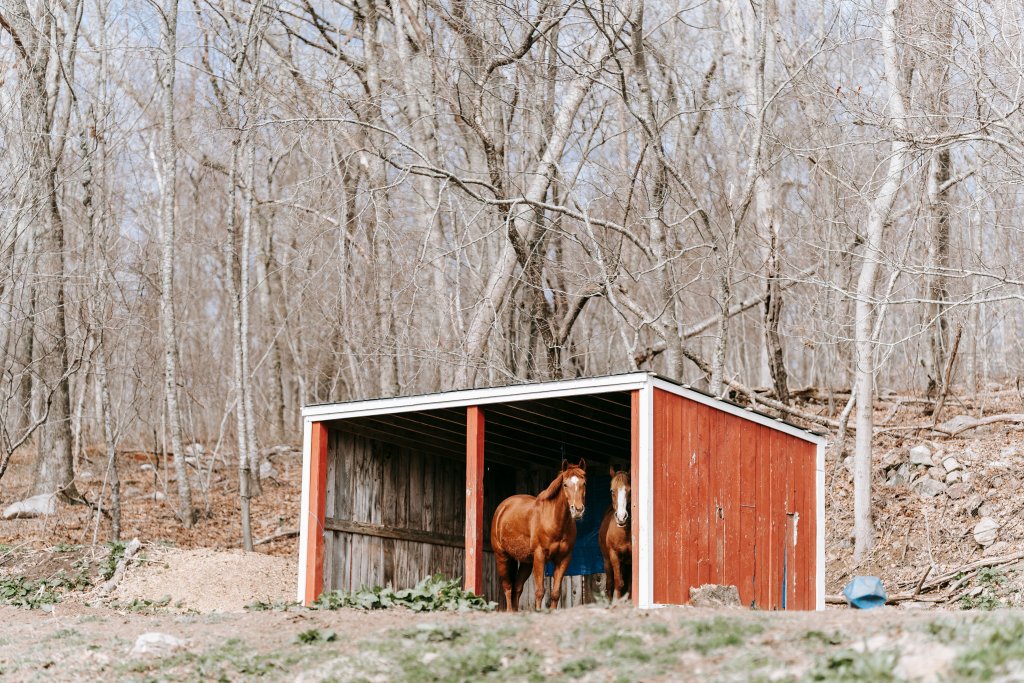
If you keep horses on pasture, you have probably wondered whether you need a full enclosed barn or whether one of the open-sidedhorse run in sheds you see on small farms is enough.
It is a fair question, and the answer depends more on your climate, your herd, and how you manage your land than on any single rule. A run-in shed is a simple idea, but there is more to getting one right than most people expect, and a poorly placed or undersized shed can end up being ignored by the very horses it was built for.
This guide walks through what a horse run-in shed actually is, how it differs from a traditional barn, why the open-sided design matters for horse health, and what you need to think about before you put one on your property.
Whether you are new to horses or just moving from a boarding situation to your own land, this should give you a clear picture of what you are building and why.
What a Horse Run-In Shed Actually Is
At its most basic, a run-in shed is a three-sided roofed structure with one open side that horses can walk into and out of freely. There is no stall door, no aisle, no closed-off stalls inside.
The horse decides when to go in and when to come out, which is why these shelters are sometimes called free-access or loose housing shelters.
The point of the structure is to give horses a way to get out of the worst of the weather without confining them. Horses in the wild move constantly, and a pasture-kept horse that can choose between open ground and a roofed shelter will generally do what is best for its own comfort.
That freedom of movement is the core idea behind the design, and it is what separates a run-in shed from a barn with stalls.
Most run-in sheds are built with a wood frame, a metal or shingled roof, and solid back and side walls. The open front faces away from the prevailing wind, and the roof overhangs enough to keep rain from blowing straight in.
Sizes vary, but a common starting point is 12 feet deep by 12 to 24 feet wide for one or two horses, with larger sheds built in 12-foot increments for bigger herds.
How It Differs From a Traditional Barn
A traditional barn is an enclosed building with stalls, an aisle, doors that close, and usually a loft or storage area. Barns are built for a management style where horses are brought in at night, fed in stalls, and turned out during the day.
They are also built for climates where deep cold, heavy snow, or serious wind makes an open shelter inadequate for part of the year.
A run-in shed is built for the opposite approach. The horse lives out full time and uses the shed as a refuge, not a residence. There is no daily bringing in and turning out, no stall cleaning in the traditional sense, and no closed doors.
The tradeoff is that you give up the control and convenience of a barn, where each horse is in a known place at a known time, in exchange for a setup that is cheaper to build, easier to maintain, and often better for the horse’s respiratory and mental health.
Cost is a real factor. A basic run-in shed can be built or bought for a fraction of what a finished barn costs, and it does not require a concrete foundation, full electrical service, or a complex permit process in most areas. For a small farm with a few horses, that difference can be the deciding factor.
Why the Open-Sided Design Matters for Horse Health
The open front is not just a cost saving. It is the feature that does most of the work. Horses produce a surprising amount of moisture and ammonia through breathing, manure, and urine, and in an enclosed barn with limited airflow those gases and that moisture build up fast.
Poor air quality is one of the main reasons pasture-kept horses tend to have fewer respiratory problems than stalled horses, and a run-in shed keeps that advantage while still giving shelter from sun, rain, and wind.
The open side also lets heat escape in summer. A closed barn in August can become dangerously hot, especially with a metal roof and no ventilation. A run-in shed with a high roof and an open front stays close to ambient temperature, which is exactly what you want when the goal is shade rather than warmth.
There is a behavioral side to this as well. Horses are herd animals and they take turns, sometimes uneasily, around resources. In a barn with stalls, a dominant horse can guard a doorway and keep lower-ranking horses from passing through.
In a well-sized run-in shed with a wide open front, there is no single choke point, so the whole herd can come and go without the kind of confrontation that leads to kicks and injuries. This is why shed width matters as much as depth, and it is a point a lot of first-time builders miss.
Sizing a Run-In Shed for Your Herd
The general rule of thumb is to allow at least 100 to 150 square feet of sheltered space per horse, with more room always being better than less.
A 12-by-24-foot shed is a common size for two to three horses, and a 12-by-36 or 12-by-48 works for larger herds. Going too small is the most common mistake, because a tight shed creates the exact conflict problem the open design is supposed to avoid.
Height matters too. A shed that is too low traps heat and feels claustrophobic to a horse, and a horse that feels cornered will not use the shed.
Aim for at least 8 to 10 feet of clearance at the front, with the roof sloping down toward the back. The overhang on the open side should be long enough to keep driving rain out, usually 2 to 4 feet depending on your typical weather.
If you have a mixed herd with a clear boss horse, consider a shed that is wider rather than deeper. A wide shed gives submissive horses an escape route along the back wall, while a deep narrow shed funnels everyone toward the front and can create a blocking situation.
Where to Put It on Your Property
Placement is where a lot of run-in sheds go wrong. The open side should face away from the direction that weather usually comes from, which in most of the country means south or southeast, but you should check your own prevailing wind pattern rather than assume.
A shed that faces the wrong way will let wind and rain blow straight in, and the horses will simply not use it.
Drainage is the other big one. A shed at the low point of a field will turn into a mud pit within a season, and mud around a shelter is one of the worst things for hoof health.
Pick a slightly raised spot, and if the natural ground does not drain well, bring in gravel or a compacted base before you set the shed.
The floor inside should stay dry, or at least dry out quickly after a rain, and that only happens if water moves away from the site rather than pooling in it.
Keep the shed close enough to a water source and a feed area that you are not carrying everything across the field, but far enough from fences and gates that the ground around it does not get torn up by constant traffic.
A few feet of gravel or crushed stone around the entrance goes a long way toward keeping the area usable through the wet months.
Flooring Options and What to Avoid
The floor of a run-in shed takes a lot of abuse, and the right choice depends on your climate and your budget. Bare dirt is the cheapest and it is fine in dry climates, but in wet areas it turns to mud and then to a hole as horses paw and stand.
Concrete is durable and easy to clean but it is hard on legs and it gets slippery when wet, so it is usually a poor choice for a horse shelter unless you cover it with thick rubber mats.
The middle ground that most horse owners land on is a compacted gravel or crushed stone base, topped with rubber stall mats in the area where horses stand most.
This drains well, it is firm underfoot, and it can be scraped clean with a manure fork. Whatever you choose, plan to pick manure out of the shed regularly, because a run-in shed that is never cleaned becomes a fly and parasite problem fast.
What a Run-In Shed Will Not Do
It is worth being honest about the limits. A run-in shed will not protect a horse from a serious windstorm or a driving blizzard, and in true cold-country winters some horses need more. It will not give you a place to do veterinary work or farrier work in the kind of controlled environment a barn provides.
And it will not separate horses for feeding, which means if you have a horse that needs a special diet or needs to be kept away from the herd, a run-in shed alone is not enough.
For a lot of small farms, the answer is a run-in shed as the everyday shelter and a small enclosed area or barn aisle for the times you need more control. The shed does the daily work, and the barn handles the exceptions.
A Few Details That Make a Big Difference
Overhang the roof on the open side to keep rain out. Use screws and hardware rated for outdoor exposure, because these sheds live in weather.
Put a kick board along the inside of the walls so a horse cannot push through the siding. And if you are in a high-snow area, build the roof to carry the load, because a collapsed shed is worse than no shed at all.
A run-in shed is one of the simplest structures you can put on a horse farm, and it is also one of the most useful.
Built right, sized for your herd, and placed on well-drained ground, it gives your horses a dry, shady, windbreak spot to take shelter on their own terms, which is about as close to a natural setup as a domestic horse gets.